

ABOUT US

To nurture well-rounded, globally-minded, lifelong learners:

  • ‘Well-rounded’ recognises the need for personal learning and international learning, not just subject learning.
  • ‘Globally minded’ recognises the need for students to learn about the wider world and our place in it.
  • ‘Lifelong learners’ recognises that we live in a rapidly changing society and children of today need to acquire the attitudes and skills that are needed to be successful as learners, not simply successful in learning.

To deliver affordable, high-quality international education in a safe and caring environment.

Connecting Hearts, Inspiring Minds

At Anne Hill International School, we commit to:

  1. Prioritising the wellbeing and safety of our students
  2. Delivering quality teaching and learning
  3. Upholding and inculcating our school values
  4. Keeping school fees fair and transparent
  5. Ensuring timely enrolment for all eligible students
  6. Building a diverse and inclusive school community
  7. ⁠Valuing open and honest communication with parents
  8. ⁠Supporting families and communities in times of need
  9. ⁠Caring for the environment and promoting sustainability
  10. Upholding our commitments through consistent actions

At Anne Hill International School (AHI), we are guided by a shared set of statements that define who we are as a school. These statements anchor our decision-making and the school initiatives we implement, ensuring that we remain true to our core principles and consistently responsive to the evolving needs of the students, families and community we serve.

High-quality teaching and learning at Anne Hill International School therefore includes the development of fundamental skills and ways of working not just equipping our students with specific knowledge and skills but enabling them to engage successfully with others as citizens within the global community.

We view high-quality learning as a process by which our students learn to become:

  • To be adaptable – I am open to new ideas and experiences and manage my feelings during times of change.​​
  • To be a collaborator – I try to help others and work well as part of a team.​​
  • To be a communicator – I listen attentively, ask questions to seek clarification, and express myself clearly and with confidence. ​
  • To be empathetic – I can recognise how others are feeling and treat others with kindness.​​
  • To be ethical – when faced with a difficult choice, I always try to do the right thing.​​
  • To be humble – I am modest about my achievements and recognise all the people and other factors that helped me to be successful.​​
  • To be respectful – I am polite and courteous towards others.​​
  • To be resilient – I keep trying when something is difficult and recover quickly from disappointment.​​
  • To be a thinker – I go beyond my first thoughts.​​


Intercultural learning at AHI is more than just “celebrating” but has a meaningful purpose and refers to the acquisition of knowledge, skills, and attitudes (e.g., open-mindedness, inquiry, and curiosity) that support the ability of learners to understand culture and to interact with people from cultures different from their own. It is developmental in the sense that learners advance through stages of progressively more sophisticated levels of understanding. This understanding includes that of distinct cultures as well as their own.

Specifically, to develop cultural awareness, it is important for a student to have a sense of cultural self-awareness, which will form the basis for the comparisons that are inevitably made by the learner. Intercultural learning may be designed to be culture specific by dealing with a single culture, or culture general by focusing on universally applicable skills such as perspective taking, active listening, and language acquisition.

Intercultural learning at AHI is the response to school and classroom diversity, aiming to go beyond passive co-existence. It aims to develop competencies (e.g. empathy, observation, flexibility, conflict resolution and tolerance of ambiguity) to achieve a developing and sustainable way of living together in multicultural societies. In this context the school will promote the UN Convention on the Rights of the Child and provide learning for students to understand the contexts that transform children’s lives around the world. We emphasise these aspirations in our School Values and our hope for our students is that they become true global citizens.

We believe it is the role of schools to help students become valuable, not through isolated intelligence, but through context, connection and compassion, and through the development of any passion, talent or skill that elevates the human condition. Global citizenship offers not just a traditional measure of a student’s intelligence, but of the overall value they will bring to their university, college, workplace, community, and indeed, to the world at large.

In pursuit of learning, AHI will promote the UNESCO Sustainability Goals, sspecifically, in this context the Goal 4.7: Education for sustainable development and global citizenship. Additionally, the school will promote the OECD Global Competence Framework.

At Anne Hill International School (AHI), we are guided by a shared set of statements that define who we are as a school. These statements anchor our decision-making and the school initiatives we implement, ensuring that we remain true to our core principles and consistently responsive to the evolving needs of the students, families and community we serve.

Our Vision

To nurture well-rounded, globally-minded, lifelong learners:

  • ‘Well-rounded’ recognises the need for personal learning and international learning, not just subject learning.
  • ‘Globally minded’ recognises the need for students to learn about the wider world and our place in it.
  • ‘Lifelong learners’ recognises that we live in a rapidly changing society and children of today need to acquire the attitudes and skills that are needed to be successful as learners, not simply successful in learning.

Our Mission

To deliver affordable, high-quality international education in a safe and caring environment.

Our Slogan

Connecting Hearts, Inspiring Minds

Our 10 Commitments to Parents

At Anne Hill International School, we commit to:

  1. Prioritising the wellbeing and safety of our students
  2. Delivering quality teaching and learning
  3. Upholding and inculcating our school values
  4. Keeping school fees fair and transparent
  5. Ensuring timely enrolment for all eligible students
  6. Building a diverse and inclusive school community
  7. ⁠Valuing open and honest communication with parents
  8. ⁠Supporting families and communities in times of need
  9. ⁠Caring for the environment and promoting sustainability
  10. Upholding our commitments through consistent actions

School Values

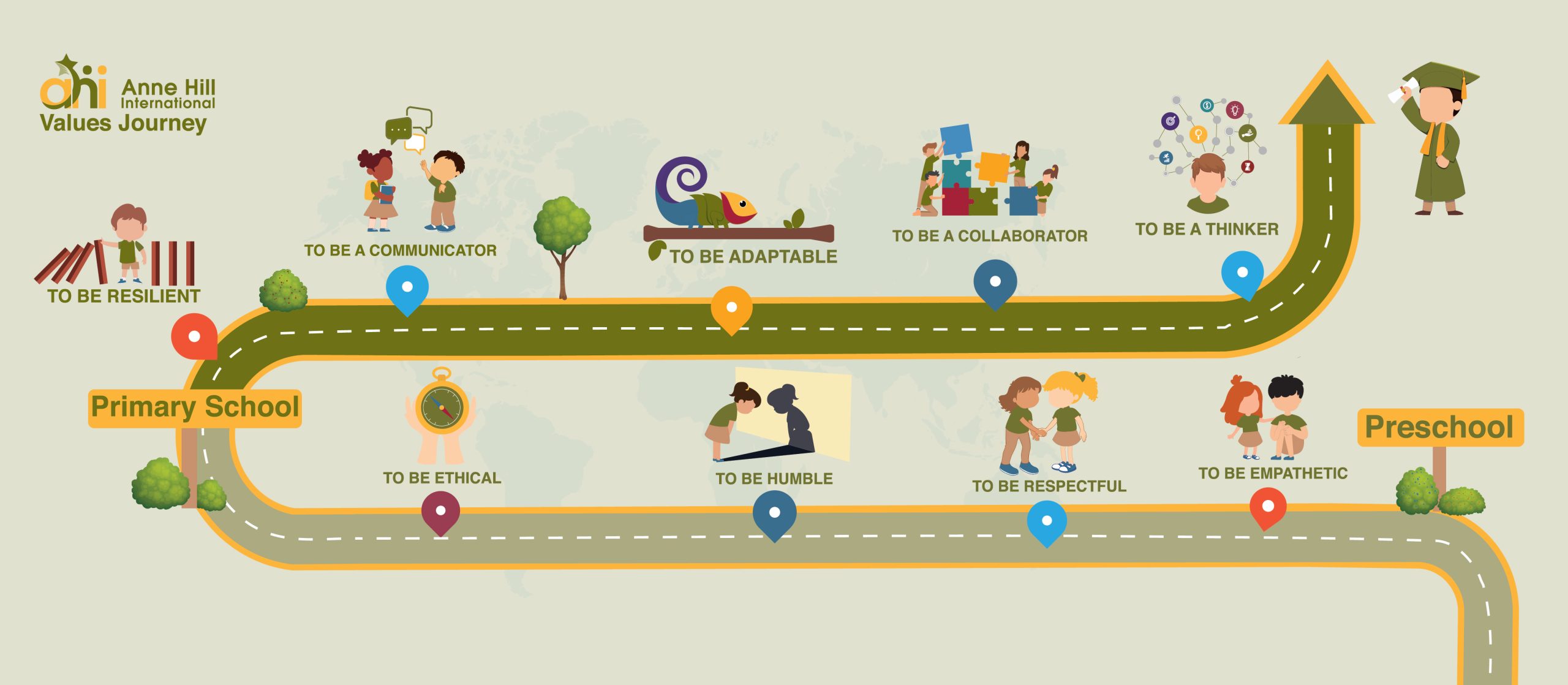
At Anne Hill International School, we nurture nine core values that prepare students for the 21st century and empower them to positively impact their local and global communities. These values help students develop personal attributes that deepen their understanding of the world and their own learning journey. Learning these values is a gradual process: in preschool, students are introduced to empathy, respect, humility and ethics, while in primary school they build on this foundation by developing resilience, communication, adaptability, collaboration and critical thinking.
Definition of High-Quality Learning & Teaching

High-quality teaching and learning at Anne Hill International School therefore includes the development of fundamental skills and ways of working not just equipping our students with specific knowledge and skills but enabling them to engage successfully with others as citizens within the global community.

We view high-quality learning as a process by which our students learn to become:

  • To be adaptable – I am open to new ideas and experiences and manage my feelings during times of change.​​
  • To be a collaborator – I try to help others and work well as part of a team.​​
  • To be a communicator – I listen attentively, ask questions to seek clarification, and express myself clearly and with confidence. ​
  • To be empathetic – I can recognise how others are feeling and treat others with kindness.​​
  • To be ethical – when faced with a difficult choice, I always try to do the right thing.​​
  • To be humble – I am modest about my achievements and recognise all the people and other factors that helped me to be successful.​​
  • To be respectful – I am polite and courteous towards others.​​
  • To be resilient – I keep trying when something is difficult and recover quickly from disappointment.​​
  • To be a thinker – I go beyond my first thoughts.​​

Definition of Intercultural Learning

Intercultural learning at AHI is more than just “celebrating” but has a meaningful purpose and refers to the acquisition of knowledge, skills, and attitudes (e.g., open-mindedness, inquiry, and curiosity) that support the ability of learners to understand culture and to interact with people from cultures different from their own. It is developmental in the sense that learners advance through stages of progressively more sophisticated levels of understanding. This understanding includes that of distinct cultures as well as their own.

Specifically, to develop cultural awareness, it is important for a student to have a sense of cultural self-awareness, which will form the basis for the comparisons that are inevitably made by the learner. Intercultural learning may be designed to be culture specific by dealing with a single culture, or culture general by focusing on universally applicable skills such as perspective taking, active listening, and language acquisition.

Intercultural learning at AHI is the response to school and classroom diversity, aiming to go beyond passive co-existence. It aims to develop competencies (e.g. empathy, observation, flexibility, conflict resolution and tolerance of ambiguity) to achieve a developing and sustainable way of living together in multicultural societies. In this context the school will promote the UN Convention on the Rights of the Child and provide learning for students to understand the contexts that transform children’s lives around the world. We emphasise these aspirations in our School Values and our hope for our students is that they become true global citizens.

Definition of Global Citizenship

We believe it is the role of schools to help students become valuable, not through isolated intelligence, but through context, connection and compassion, and through the development of any passion, talent or skill that elevates the human condition. Global citizenship offers not just a traditional measure of a student’s intelligence, but of the overall value they will bring to their university, college, workplace, community, and indeed, to the world at large.

In pursuit of learning, AHI will promote the UNESCO Sustainability Goals, sspecifically, in this context the Goal 4.7: Education for sustainable development and global citizenship. Additionally, the school will promote the OECD Global Competence Framework.