
The Secondary School serves students aged 11 to 18, a stage of exploration, self-discovery, and growing independence. Our curriculum combines the International Middle Years Curriculum (IMYC), the International General Certificate of Secondary Education (IGCSE), and Cambridge A Level, guiding learners from early adolescence to university readiness. Each stage balances academic rigour with social-emotional growth, helping students become confident, responsible, and globally minded.
Learning goes beyond textbooks through projects, leadership opportunities, and community engagement, supported by a strong Personal, Social and Health Education (PSHE) programme that nurtures resilience and empathy. What makes our curriculum unique is its holistic, bilingual, and globally connected approach — linking knowledge with real-world relevance and preparing students not just for exams, but for life.
All students follow the same core curriculum which includes English, Mathematics, Science, International Middle Years Curriculum (IMYC), Physical Education, Music, Art, and Personal, Social and Health Education (PSHE). Students also select an additional language from either Mandarin or Vietnamese. Vietnamese students we offered the Vietnamese national language curriculum. Students whose native language is not English have the opportunity to study English as an Additional Language (EAL).
The curriculum is a two year programme of studies leading to the external International General Certificate of Secondary Education (IGCSE). Students follow a core curriculum of English, Mathematics, Coordinated Science, Physical Education and PSHE. In addition, students study Design Technology, Business Studies and Global Perspectives. Vietnamese students are offered ISCSE Vietnamese and national language curriculum. The study of Mandarin and Spanish is also available.
Our Secondary programme offers a broad and balanced range of subjects that develop both academic excellence and personal growth. Students study core disciplines alongside creative, technological, and physical subjects, ensuring a well-rounded education that nurtures critical thinking, collaboration, and global awareness. The subject structure evolves through each stage — from a wide foundation in Lower Secondary, to focused IGCSE specialisations, and finally to advanced, self-directed A Level studies — preparing students for success at university and beyond.

Description here

Lorem ipsum dolor sit amet, consectetur adipiscing elit. Ut elit tellus, luctus nec ullamcorper mattis, pulvinar dapibus leo.
Lorem ipsum dolor sit amet, consectetur adipiscing elit. Ut elit tellus, luctus nec ullamcorper mattis, pulvinar dapibus leo.
Lorem ipsum dolor sit amet, consectetur adipiscing elit. Ut elit tellus, luctus nec ullamcorper mattis, pulvinar dapibus leo.
Lorem ipsum dolor sit amet, consectetur adipiscing elit. Ut elit tellus, luctus nec ullamcorper mattis, pulvinar dapibus leo.
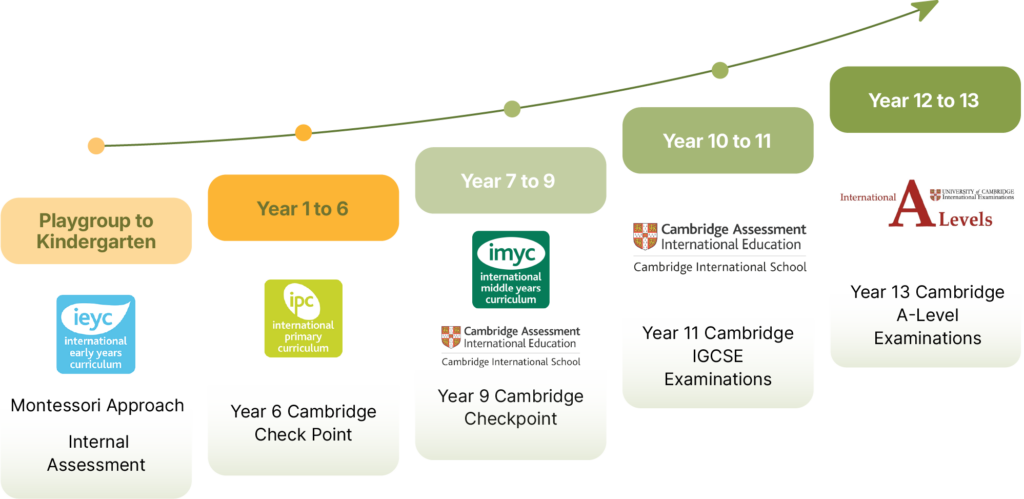
AHI has chosen the International Middle Years Curriculum (IMYC) and the Cambridge pathway because together they provide a clear, academically rigorous and well-structured journey from Primary through to internationally recognised qualifications.
Together, these create a coherent and well-supported journey: IPC in Primary → IMYC in Lower Secondary → Cambridge IGCSEs and A Levels in Upper Secondary. Each phase prepares students steadily for what comes next.
In Years 7–9, students are assessed through a thoughtful combination of ongoing classroom work and more formal assessments. In IMYC subjects – such as Humanities, Art, Music and Design – students are assessed against clearly defined Subject, Personal and International Learning Goals. Each unit includes:
In core subjects, assessment includes:
Across all subjects, assessment may include written examinations, practical investigations, extended writing, projects, presentations and digital outcomes. In subjects such as Computing, PE and Drama, assessment focuses primarily on practical performance and project work.
In Upper Secondary, assessment is centred around the Cambridge IGCSE programme. Students follow a two-year course in each subject, with assessment carried out through a combination of written examinations, coursework and practical components – depending on the subject. All IGCSE examinations are externally set and marked by Cambridge Assessment International Education, ensuring internationally recognised standards and results.
The assessment structure varies by subject:
Throughout Years 10 and 11, internal assessments, mock examinations and coursework milestones are used to monitor progress and prepare students for their final examinations. IGCSE results provide a strong academic foundation for progression to A Levels – qualifications that are highly valued by universities worldwide.
At IGCSE level (Years 10–11), students follow a structured academic programme accredited by Cambridge Assessment International Education. For the initial phase (Academic Year 2026–27), all subjects are compulsory, ensuring students build a broad and balanced academic foundation before subject choices are introduced in later phases.
Students will study:
Languages are taught through a bespoke curriculum designed to meet the needs of our students, and where appropriate and available, students may be offered the opportunity to sit an IGCSE qualification in their chosen language.
Alongside their examined subjects, students also take part in Physical Education (PE) and Personal, Social and Health Education (PSHE). These subjects are not examined at IGCSE but remain an important part of the timetable, supporting students’ wellbeing, personal development and preparation for life beyond school.
We believe that reporting should give families a clear and meaningful picture of their child’s progress – both in terms of academic achievement and how they engage with learning.
Lower Secondary School (Years 7–9)
ATTAINMENT
ENGAGEMENT
In addition, parents receive a separate end-of-year report for their child’s chosen language of study – either Vietnamese or Mandarin. This report covers Listening Comprehension, Basic Conversation, Reading and Pronunciation, Writing and Learning Attributes.
Upper Secondary School (Years 10–13)
In Upper Secondary, attainment is assessed using the internationally recognised Cambridge IGCSE and A Level grading system:
| GRADE | LEVEL OF ACHIEVEMENT |
|---|---|
| A* / A | High Achievement |
| B / C | Good Achievement |
| D / E | Basic Achievement |
| F / G | Limited Achievement |
| U | Ungraded |
Engagement is also reported using the same four-level scale as in Lower Secondary.
We are happy to share that the transition from IB to IPC or IMYC is generally a smooth and positive experience for students. All three programmes share a commitment to enquiry-based learning, international mindedness and the development of the whole child.
There are some structural differences worth noting:
Any challenges during the transition are typically short-term and relate to differences in terminology, assessment language or classroom routines – not academic difficulty. Because the core values of enquiry, reflection and global awareness are shared across all three programmes, most students adapt quickly and thrive in their new environment.
AHI follows an international curriculum pathway and does not issue official academic transcripts from Vietnam’s Ministry of Education and Training (MOET), as we do not follow the Vietnamese national curriculum.
Instead, students complete internationally recognised qualifications through Cambridge Assessment International Education, including Cambridge IGCSEs and A Levels. These are official, externally assessed qualifications accepted widely for school transfers, university applications and future employment opportunities around the world.
Delivering affordable, high-quality international education where every child feels safe, supported, and inspired to learn.
Thank you for your interest in Anne Hill International School.
Our Admissions Team will contact you within 24 hours.