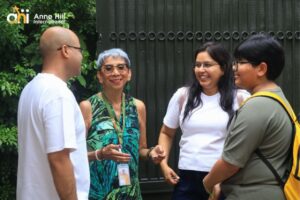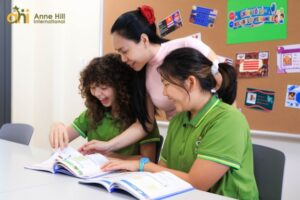


Photo: Year 6 students preparing for Cambridge Checkpoint at Anne Hill International School, Ho Chi Minh City
Cambridge, International Baccalaureate (IB) and American schools in Vietnam all lead to university, but they differ in structure, assessment and how easily a child can move between systems. If you may move again, the transfer question matters most.
In This Article
- Cambridge curriculum vs IB vs American: how do they compare?
- If we move to a different system, can my child keep up?
- What help is there if English is not my child’s first language?
- What does Anne Hill teach, from Preschool to Secondary?
- Questions parents ask
Cambridge curriculum vs IB vs American: how do they compare?
All three can take your child to university; they differ in who sets them, how they are built and how they are assessed. Cambridge and the IB are each run by one international organisation. There is no single American curriculum: in the US, states and communities develop curricula and set graduation requirements, so ask each American school in Vietnam which US standards it follows. Some add Advanced Placement (AP) courses in high school.
The table sets out what each organisation publishes about its own programmes.
| Comparison | Cambridge | IB (International Baccalaureate) | American |
|---|---|---|---|
| Who sets it | Cambridge International Education | The International Baccalaureate | No single body: in the US, states and communities develop curricula and set graduation requirements; ask each school which US standards it follows |
| Stages and ages | Early Years from 3, Primary from 5, Lower Secondary from 11, Upper Secondary from 14, Advanced from 16 | Primary Years Programme 3 to 12, Middle Years Programme 11 to 16, Diploma Programme or Career-related Programme 16 to 19 | Set by each school; AP courses are taken in high school |
| Main qualifications | Cambridge International General Certificate of Secondary Education (IGCSE) for 14 to 16 year olds (over 70 subjects); Cambridge International AS & A Level (more than 50 subjects) | IB Diploma: 6 subjects, plus Theory of Knowledge, the Extended Essay and Creativity, Activity, Service | Graduation from high school, with AP exams alongside where the school offers them |
| How it is assessed | IGCSE: at the end of the course, through written, oral, coursework and practical assessment | Diploma: mainly written exams at the end of the course, plus coursework and in-school tasks, some marked by teachers and moderated by the IB; each subject graded 1 to 7, up to 45 points in all, diploma from 24 points plus other conditions | AP: exams in May, scored 1 to 5 |
| Recognition, in each organisation’s words | IGCSE and AS & A Level accepted as equivalent to UK GCSE and A Levels by leading universities worldwide | Each year, over 4,500 universities in more than 110 countries and territories receive IB students’ transcripts | Nearly all US colleges and universities grant credit and placement for qualifying AP scores |
None of the three is right for every child. The better question is which one your child can continue, wherever your family goes next.
If we move to a different system, can my child keep up?
Usually, yes, and timing matters. Moves are simplest between stages, because Cambridge IGCSE and the IB Diploma are each 2-year courses.
Our own answer to this question focuses on skills that travel with a child. We follow a UK-based international framework, with programmes such as White Rose Maths and synthetic phonics, and we build skills such as critical thinking, literacy and numeracy that transfer from one school to the next.
From the IB to Anne Hill International School: moving from IB programmes to the International Primary Curriculum (IPC) or International Middle Years Curriculum (IMYC) is generally smooth, because all three share enquiry-based learning and international mindedness. Early challenges tend to be new terms, assessment language and routines, not academic difficulty.
From Cambridge to the IB: the IB Diploma starts at 16, the age a student finishes Cambridge IGCSE, so the end of Year 11 is a natural point to switch.
To or from an American school: class names differ, and our Year 2 is the same age group as the first year after kindergarten in the US. Graduation requirements differ from school to school, so ask the new school what your child will need to graduate.
If you are choosing a Cambridge curriculum school in Vietnam and may move again, ask which Cambridge stages the school teaches, which Cambridge tests your child will sit and which records you will take with you.
What help is there if English is not my child’s first language?
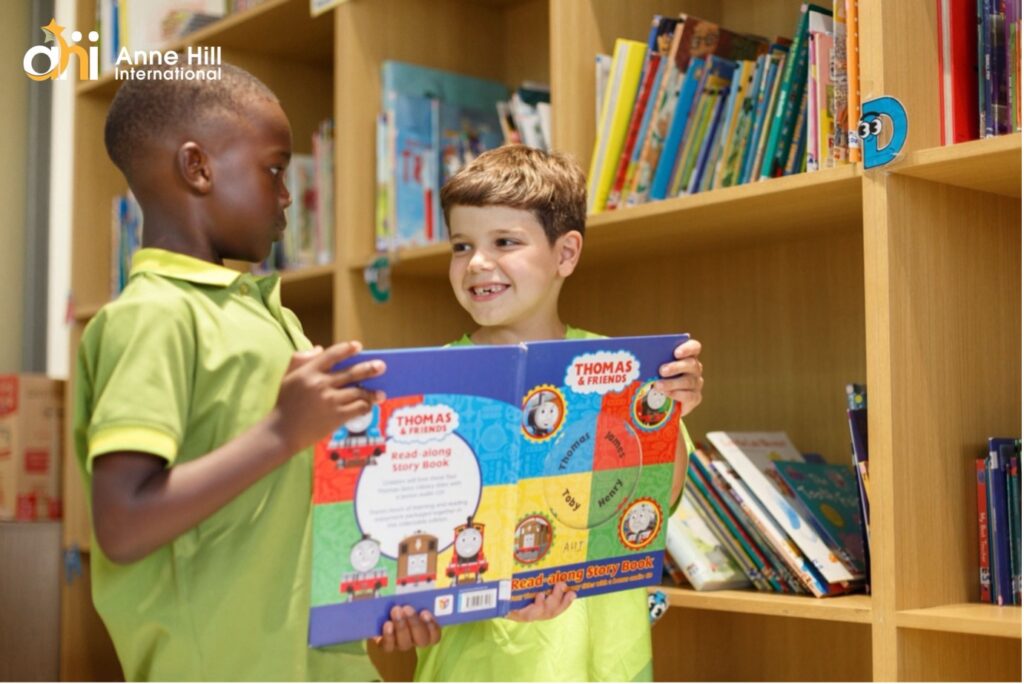
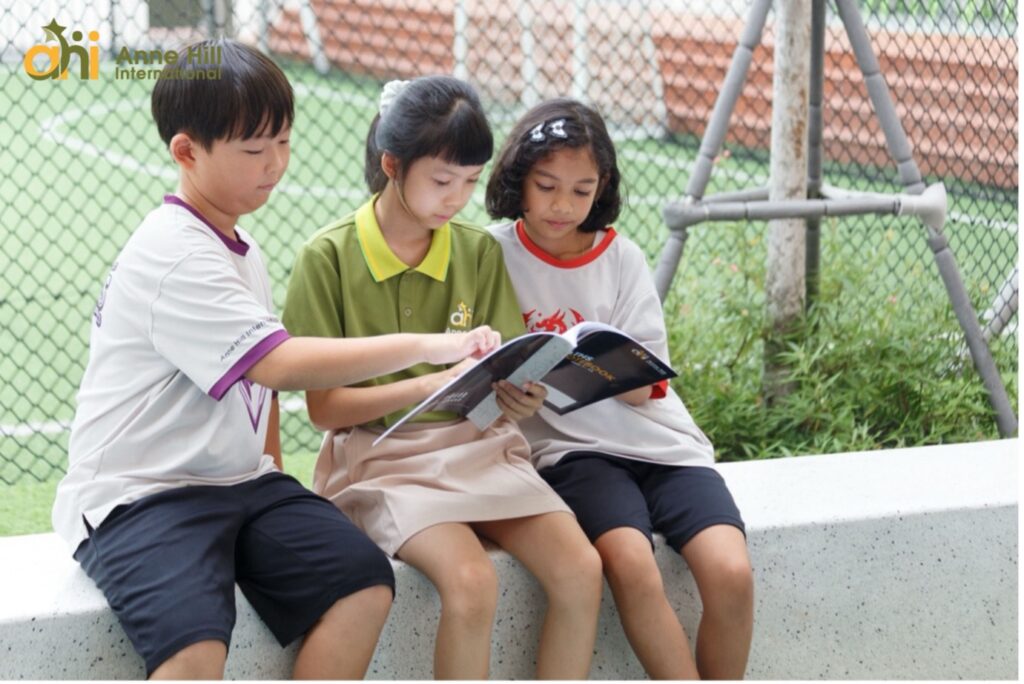
Photo: Primary students reading a storybook together at the library in Anne Hill International School
Ask two things on every tour: how the curriculum makes room for language learners, and what extra support the school adds. Here is what each organisation offers:
Cambridge: Cambridge IGCSE includes English as a Second Language among its subjects.
IB: IB programmes can be fully taught and assessed in English, French or Spanish. For learning a new language in the Diploma, the IB offers language ab initio for beginners and Language B for students with some experience of the language.
American schools: support for English learners is decided by each school, so ask what it provides.
At Anne Hill International School, children whose first language is not English, or who come from a school that did not teach in English, take an English proficiency assessment when they apply. From age 5, the Oxford Young Learners Placement Test finds each child’s level, and those who need it join our English as an Additional Language (EAL) programme; younger children are assessed during Kindergarten. Selected Primary students can also join an After-school English Programme, and at IGCSE students take First Language English or EAL, where appropriate.
What does Anne Hill teach, from Preschool to Secondary?
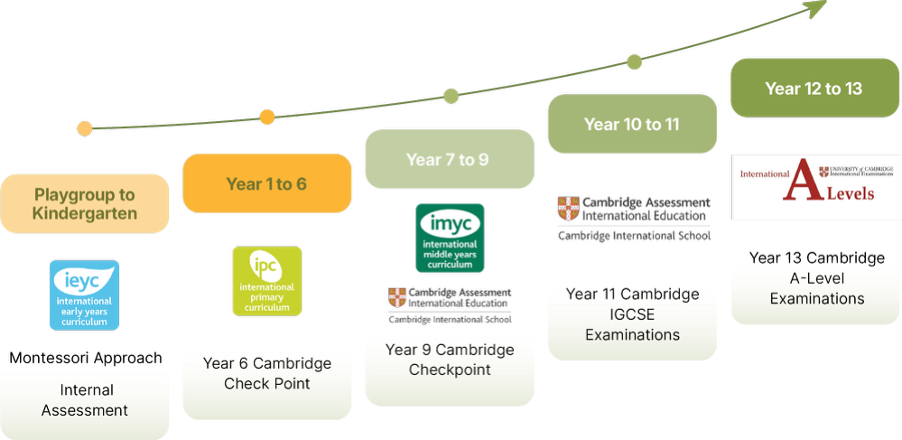
Photo: An overview of AHI’s educational pathway, from Early Years through to A-Levels
Anne Hill International School follows one connected pathway, from the International Early Years Curriculum (IEYC) to Cambridge A Level. As a Cambridge school in Ho Chi Minh City, we use Cambridge Checkpoint tests, set and marked by Cambridge, to benchmark progress.
Preschool, 18 months to 5 years: the IEYC as our main curriculum, with Montessori, Jolly Phonics and Numicon, and Mandarin and Vietnamese as second languages.
Primary, Year 1 to Year 6: the IPC, and as a registered Cambridge International School for Cambridge Primary, Year 6 sits Cambridge Checkpoint in English, Maths and Science. In May 2026, our Year 6 averaged 34.4 out of 50, the highest the school has recorded.
Secondary: the IMYC in Years 7 to 9, with Cambridge Lower Secondary Checkpoint in Year 9; Cambridge IGCSE in Years 10 and 11; then Cambridge A Level. In 2026-2027, our secondary classes run to Year 13.
We chose the IMYC because it is designed for 11 to 14 year olds and continues the enquiry-based learning of the IPC, and the Cambridge pathway because IGCSEs and A Levels are externally set and marked. Read more about our curriculum, the Preschool curriculum, the Primary School curriculum and the Secondary School curriculum.
Questions parents ask
Is the Cambridge curriculum recognised by universities?
Cambridge says its IGCSE and International AS & A Levels are accepted as equivalent to UK GCSE and AS & A Levels by leading universities worldwide, and that 95% of students taking Cambridge International AS & A Levels go on to university. Entry rules differ by university and course, so check the universities your child is considering in Cambridge’s recognition search.
Can a Cambridge student move to an IB school?
Usually, yes, at 16. The IB Diploma Programme is for students aged 16 to 19, and Cambridge IGCSE is for 14- to 16-year-olds, so a student who finishes IGCSE arrives at the age the Diploma begins. Ask the IB school early which subjects and levels it expects, because Diploma students choose 6 subjects, 3 or 4 of them at higher level.
What is the Cambridge curriculum?
It is the Cambridge Pathway from Cambridge International Education: 5 stages from Early Years (from age 3) to Advanced (from age 16), with Cambridge IGCSE and AS & A Level as its qualifications for older students. Schools can offer the stages together or separately, and over 10,000 Cambridge schools in 160 countries follow it.
Is the Cambridge curriculum good for a child who may move again?
It can be. With over 10,000 Cambridge schools in 160 countries, a child who moves may be able to continue at another Cambridge school. The IB and AP are also offered by schools in many countries, so the right fit depends on where you may go next and how your child learns.
See the Anne Hill Pathway for Yourself
Book a school tour: see the classrooms, meet the teachers and ask your questions. If your child is moving from another system, bring their latest school reports so we can talk about placement.