


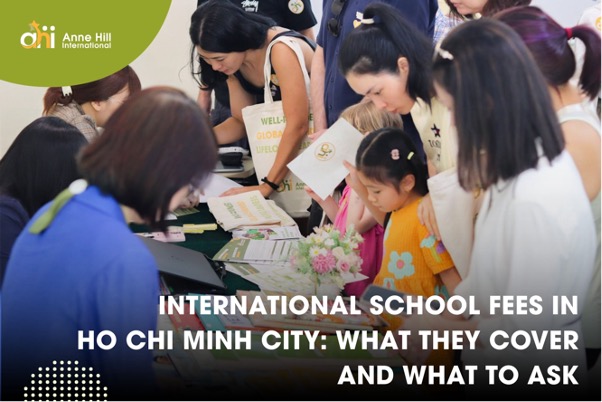
Photo: Families reading about admissions information with the Anne Hill Admissions Team during an Open Day.
International school fees in Ho Chi Minh City can include more than annual tuition: application and registration fees, deposits, meals, transport, uniforms and activities may each be charged separately. The questions below will help you compare schools like for like and understand how our own fees at Anne Hill are structured.
In This Article
- What does the tuition fee cover?
- Which extra costs should you budget for?
- 8 questions to ask every school about fees
- Can you get a discount or help with fees?
- How are Anne Hill’s fees set out?
- Questions parents ask
What Does the Tuition Fee Cover?
Tuition is the core of every fee schedule: it pays for your child’s teaching throughout the school year. What else is included is the first thing to check, because two schools with similar tuition fees can offer quite different inclusions.
Ask each school whether its tuition includes:
- Meals and snacks, and which meals are covered.
- Books, learning materials and any devices your child needs.
- Co-curricular activities, and which activities incur additional charges.
- Day trips and residential trips in older year groups.
- English language support, if your child is still learning English.
- External examination fees, in the years your child takes them.
Write down the answers for each school. A tuition fee that includes meals and activities cannot be compared directly with one that does not. When comparing international school fees in Ho Chi Minh City online, check which academic year each figure applies to and whether it is charged annually or per term.
Which Extra Costs Should You Budget For?
Beyond tuition, plan for one-time costs when your child joins and recurring costs for the services you choose. Not every school charges for all of these, so ask which apply and whether each payment is made once, annually or each term.
| Cost | What to Ask |
|---|---|
| Application or assessment fee | Is it charged before the assessment, and is it refunded if no place is offered? |
| Registration or enrolment fee | Is it paid once, or again each year? Is any of it refundable? |
| Deposit | How much is it, when is it returned, and what can be deducted from it? |
| School bus | Is the price set by route or distance, and is it billed by term or by year? |
| Meals | Are they included in tuition or billed separately? |
| Uniform | Which items are required, and where do you buy them? |
| After-school activities and care | Which are free, which are paid, and how are they billed? |
| Trips | Are day trips and residential trips included or charged separately when they take place? |
| Exam fees | Which external examinations are charged, and in which year groups? |
| Language support | Is English language support part of tuition or a separate programme with its own fee? |
Add up the compulsory items for your child’s year group. That total, rather than the tuition figure alone, is the amount you should compare between schools.
8 Questions to Ask Every School About Fees
These eight questions turn a fee schedule into a total you can compare. Ask them at every school on your shortlist, preferably in writing, so the answers are easy to review side by side.
- What is the total yearly cost for my child’s year group? Include tuition plus every compulsory charge for one full academic year.
- What does tuition include, and what is charged separately? Use the checklist above to identify any additional costs.
- Which one-time fees do new students pay, and are any refundable?
- Is there a deposit, and when and how is it returned?
- Can we pay in instalments, and does the total change if we do?
- Which currency are fees charged in, and who pays bank or conversion charges? This is particularly important if you pay from abroad.
- What happens to fees if we leave during the year? Ask about notice periods and refund policies.
- How often do fees change, and when is next year’s schedule published?
If your employer pays or reimburses your school fees, also ask which invoices the school can issue and how soon after payment you must request them.
These questions are equally useful when comparing international school fees elsewhere in Vietnam. If you are still building your shortlist, our guide to choosing an international school in Ho Chi Minh City covers what to look for beyond fees.
Can You Get a Discount or Help with Fees?
Ask each school what discounts and financial support it offers, who qualifies and how to apply. Also check whether a discount applies to tuition only or to other fees, and whether it continues in subsequent academic years.
The types of support worth asking about include:
- Sibling discounts: Available when two or more children attend the same school.
- Full-year payment discounts: A possible reduction for paying the full year’s fees in one instalment.
- Scholarships: Financial awards based on specified achievements or eligibility criteria.
- Bursaries: Financial assistance for families who meet the school’s support criteria.
- Referral programmes: Benefits for families introduced to the school by existing parents.
Financial Support and Discounts at Anne Hill
For Academic Year 2026–2027, Anne Hill offers several forms of financial support and family benefits:
Bursary Programme
Our Bursary Programme provides tuition fee support to families in need when unforeseen circumstances affect a child’s schooling.
Scholarships and Parent Referral Programme
We offer scholarships, including the Pioneer Merit Scholarship for the Secondary School, as well as a parent referral programme.
Sibling Discount
Families with two or more children enrolled at AHI receive a 10% discount on tuition fees for the sibling with the lower tuition fee. The registration fee is waived for subsequent siblings.
Loyalty Discount
Students who have previously been enrolled at AHI for at least 12 months qualify for a discount based on their enrolment duration, ranging from 1% to 6%.
How Are Anne Hill’s Fees Set Out?

Photo: Secondary students reading books in the Anne Hill school library.
Our full Academic Year 2026–2027 fee schedule is available to download from our School Fees page. It includes annual tuition by school phase and details of other charges. Here is a summary of how our fees are structured.
| School Phase | Year Groups | Annual Tuition 2026–2027 |
|---|---|---|
| Preschool | Playgroup, Nursery and Kindergarten (18 months to 5 years), half-day or full-day | Starting from 182,000,000 VND Refer to Schedule of Fees |
| Primary | Year 1 to Year 6 | Starting from 296,100,000 VND Refer to Schedule of Fees |
| Secondary | Year 7 to Year 10 | Starting from [CONFIRM AMOUNT] VND Refer to Schedule of Fees |
What Is Included in Tuition?
- Meals at school: Morning snack and lunch for Primary and Secondary students, as well as half-day Preschool students.
- Co-curricular activities (CCAs): Free for Primary and Secondary students.
One-Time Fees
- A non-refundable registration fee, subject to the applicable fee schedule.
- A security deposit.
Charged Separately
- School bus services.
- After-School Care Service (ASC), with fees detailed in the schedule.
- After-School Activities (ASAs).
Payment Options
Fees are payable in Vietnamese dong (VND), by cash or bank transfer. Families can pay in one instalment or in instalments according to the payment schedule. Red invoices are available upon request.
Questions Parents Ask
Why Do International School Fees in Ho Chi Minh City Vary So Much?
Each school sets its fees according to its own educational programme and services. Differences may reflect what tuition includes, the year group, the curriculum and examinations offered, as well as the facilities and services available to students.
That is why comparing the total yearly cost for your child’s year group provides a fairer picture than looking at the headline tuition figure alone.
Are Fees Paid Yearly or by Term?
It depends on the school, so ask for its payment schedule and whether paying in instalments changes the total amount.
At Anne Hill, families can pay the year’s tuition in one payment or in instalments, with the due dates set out in the fee schedule.
Do Schools Charge a Deposit?
Some schools require a deposit, so ask how much it is, when it is returned and what deductions may apply.
At Anne Hill, new students pay a security deposit and a one-time, non-refundable registration fee, in accordance with the applicable fee schedule.
Which Currency Are Fees Paid In?
Ask each school which currency it accepts and who is responsible for bank and currency conversion charges, particularly for payments from overseas.
At Anne Hill, fees are paid in Vietnamese dong (VND). Overseas payments must arrive as the full amount in VND, with bank and currency conversion charges covered by the payer.
Visit Anne Hill International School
Book a school tour to see our classrooms, meet the teachers and speak with our Admissions Team. You will also have the opportunity to ask questions about our programmes, admissions process and school fees.