
Setting Boundaries: The Art of Saying “No”

Discover how setting healthy boundaries with children can help families communicate their needs and build stronger, more respectful relationships.

Saying “No” to your child can sometimes lead to tears, tantrums or endless negotiations. On the other hand, hearing “No” from your child can be equally frustrating, especially when you have their best interest at heart. Parents must balance firmness with empathy, making space for their children’s feelings without compromising on their stand. However, setting boundaries is easier said than done. But with the right approach, families can learn to communicate their needs, respect each other’s limits and build healthier relationships.

What Are Boundaries?

According to Psychology Today (2022), boundaries are where individuals draw the line between themselves and others. During the Parent Workshop “No is a Two-Way Street” held on 21st October 2026 at the Vo Truong Toan campus, Ms Mili Manek defined boundaries as the emotional, physical and mental space between you and another person that enables connection without collision.
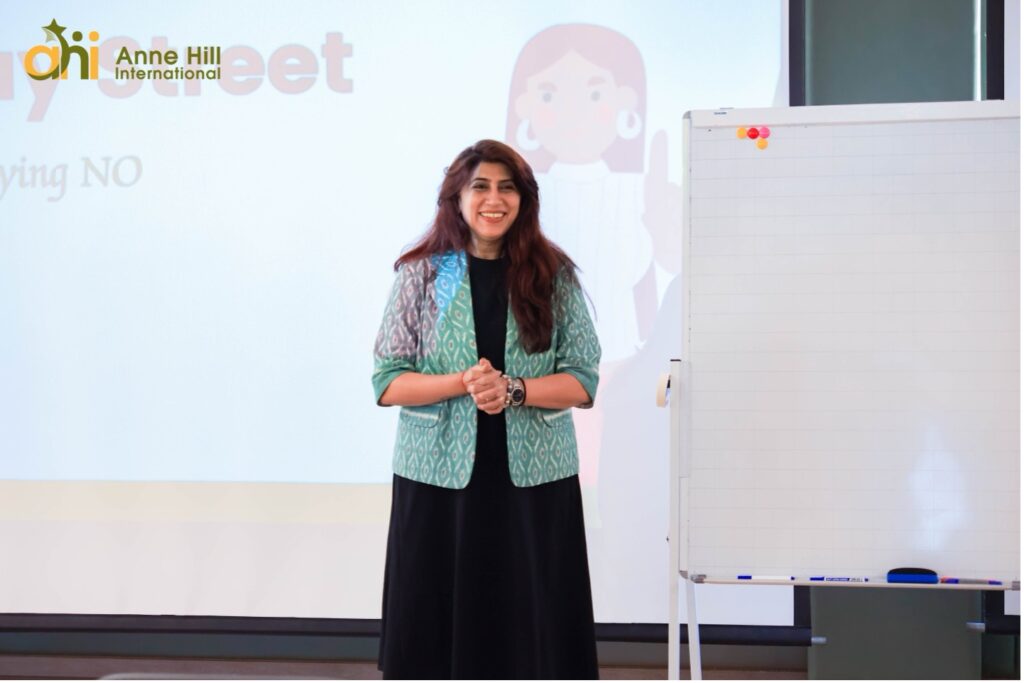
Photo: “No is a Two Way Street” Parent Workshop led by Ms Mili Manek, a Mental Health Counsellor and Educator with over 20 years of experience.

There are three categories of boundaries: Personal boundaries refer to physical space; mental boundaries relate to your thoughts, values and decisions; and emotional boundaries are all about your feelings and needs, and how they interact with others.

As Ms Mili emphasised, it is important to build and maintain healthy boundaries not only to protect your peace of mind, but to prevent exhaustion or resentment, along with having mutual respect and emotional safety with others. Recognising when boundaries are crossed can also help us better understand our own needs and limits. Signs of crossed boundaries may include feeling uncomfortable or guilty, experiencing invasions of personal space, or feeling pressured to please others at your own expense.

Becoming aware is the first step towards change. With the help of communication frameworks shared by Ms Mili, parents can learn to set healthy boundaries and communicate them with confidence and empathy.

Explore highlights from Ms Mili’s Digital Balance Parent Workshop.

The B.A.L.L. Framework: The Art of Saying ‘No’
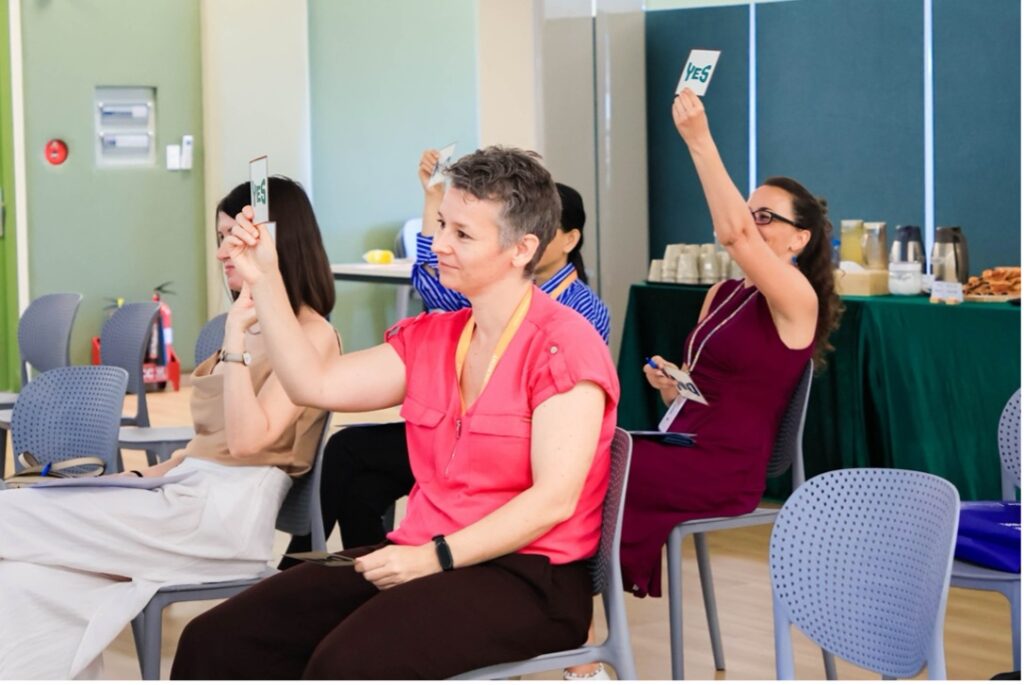
Photo: Parents respond to questions about setting boundaries with children during an icebreaker game using “Yes” and “No” cards.

When asked if they felt a surge of anxiety right before saying “No” to their child, most parents at the workshop raised their “Yes” cards, highlighting the emotional challenges that can come with setting boundaries.

The B.A.L.L. framework offers a practical approach to saying “No” clearly and respectfully, helping parents communicate their limits without unnecessary guilt.

  • B – Boundary: State your “No” clearly.
    Example: “No, you can’t have more screen time today.”
  • A – Acknowledge: Validate your child’s feelings or needs.
    Example: “I know you want to keep playing, and I understand that it’s hard to stop when you’re having fun.”
  • L – Limit: Give brief context without overexplaining or making excuses.
    Example: “It’s already past your screen time limit for today.”
  • L – Leave: Offer an alternative or another opportunity.
    Example: “You can continue playing tomorrow after you’ve finished your homework.”

Saying “No” does not mean dismissing your child’s feelings or shutting down the conversation. By setting clear limits while acknowledging their emotions with empathy, parents will show children that boundaries can coexist with care and understanding.
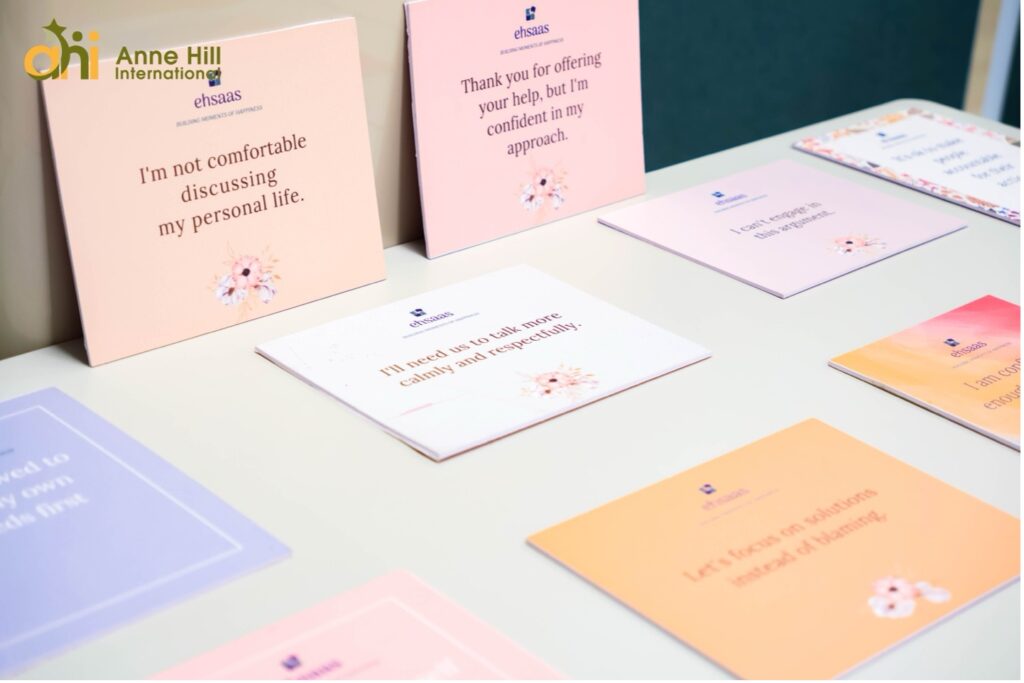
Photo: Practical phrases for setting limits, expressing discomfort and responding calmly.

The S.M.I.L.E. Framework: The Art of Receiving a “No”

Setting boundaries with children goes both ways. While parents teach their children to communicate their needs, they must also model how to respect the boundaries of others. Receiving a “No” gracefully encourages children to practice empathy, develop self-awareness and communicate respectfully. These skills can support their mental health and strengthen relationships both at home and beyond.

The S.M.I.L.E framework is a practical guide to receiving a “No” with understanding and respect, helping parents navigate responding without sounding defensive.

  • S – Stop: Pause and take a breath before reacting emotionally.
    Example: “I’m feeling upset, so I’ll take a moment before responding.”
  • M – Message: Separate the rejection from your self-worth. A “No” is not necessarily a reflection of your value as a person.
    Example: “It may be about timing, not me.”
  • I – Inquire: Ask gentle questions to understand the other person’s reasons, without pressuring them to change their answer.
    Example: “Is it because you don’t have the time right now?”
  • L – Learn: Reflect on the situation and consider what you can take away from it.
    Example: “I could have asked earlier.”
  • E – Evolve: Accept the response and move forward without dwelling on it.
    Example: “Thank you for letting me know.”

Learning to say “No” and accept it in return takes practice, but are crucial to building stronger relationships and setting boundaries with children. By setting a good example, parents can teach their children to express themselves honestly and let others do the same.

As Ms Mili reminded parents, “No is not rejection, it’s redirection.”

Sometimes, accepting a “No” simply means recognising that another path may be worth exploring.

Photo: Modelling healthy boundaries at home helps children build respectful relationships with others, including their peers at school.

Putting Boundaries into Practice

Setting boundaries is a skill that extends beyond parenting. The B.A.L.L. and S.M.I.L.E. frameworks can assist in conversations with friends, colleagues and other family members, allowing us to express our needs while respecting those of others.

Start by being intentional with how you communicate your needs in everyday life. Express them before frustration builds, take time to rest without feeling guilty, and be clear and respectful when explaining your limits rather than expecting others to guess how you feel.

A strong bond between parents and children is built on trust, understanding and respect for each other’s needs.

Remember that building healthy boundaries takes time and practice. Parents can begin with one situation at a time, focusing on what feels manageable and following through consistently, even when it feels uncomfortable. As these habits become more familiar, mutual respect will become a more natural part of family life.

Book a School Tour to discover AHI’s Nurturing Learning Environment:

Book a School Tour at Anne Hill International School

References

Inside Exit Points: Learning Through Real-World Projects

Exit Points are a celebration of learning at Anne Hill International School.

At Anne Hill International School (AHI), students demonstrate their learning in different ways, including through Exit Points, where they apply their knowledge and present their understanding through projects. However, as parents, it can sometimes be difficult to understand how these activities contribute to your child’s academic progress, especially when there is no traditional test involved. Understanding how Exit Points work, how students are assessed and how you can support your child can offer a clearer picture of this learning process.

What Is an Exit Point?

An Exit Point is the concluding stage of a unit in the International Primary Curriculum (IPC) and International Middle Years Curriculum (IMYC). It gives students an opportunity to bring together their learning, reflect on what they have understood and share their ideas with others. In the IPC, the International Curriculum Association (ICA) describes Exit Points as a way for children to consolidate their learning and celebrate their achievements.

Photo: Year 7 students presenting on the topic of Relationships.

At AHI, Exit Points celebrate students’ learning at the end of each unit. Through project-based learning, students demonstrate their knowledge and skills while working towards their final presentations, performances or exhibitions. Projects like these help students develop critical thinking skills by making meaningful connections between different subjects and the unit’s Big Idea. Understanding how their learning applies to real-world contexts helps students transfer their knowledge to new situations and solve problems beyond the classroom (National Research Council, 2000).

Exit Points contribute to students’ overall summative assessment, which consists of an Exit Point evaluation and a subject assessment. Throughout the project, teachers observe and evaluate how effectively students collaborate, communicate and apply their learning from across the unit. In terms of grades, students receive an overall attainment judgement using four levels: Working Below, Working Towards, Working At or Greater Depth. Together, these provide a holistic measure of each student’s achievement.

Learn more about the International Middle Years Curriculum (IMYC) at AHI

Read more about the International Primary Curriculum (IPC) at AHI
View this reel to know what Exit Point looks like at AHI: https://www.facebook.com/reel/1108958372055080

Preparing for Exit Points: How Parents Can Help

Photo: Year 8 students proudly presenting their group work to a parent.

IMYC Exit Points require a considerable amount of preparation, creativity and teamwork. Over the course of each unit, students work towards producing exhibitions that may include presentations, models, dioramas, posters, interactive displays and other creative projects. While students are given time in school to prepare, they are also expected to contribute to their Exit Point projects at home.

As Exit Points often involve group work, students need to take responsibility for their individual contributions. This may involve completing assigned tasks independently at home or arranging opportunities to meet and work collaboratively with their group members.

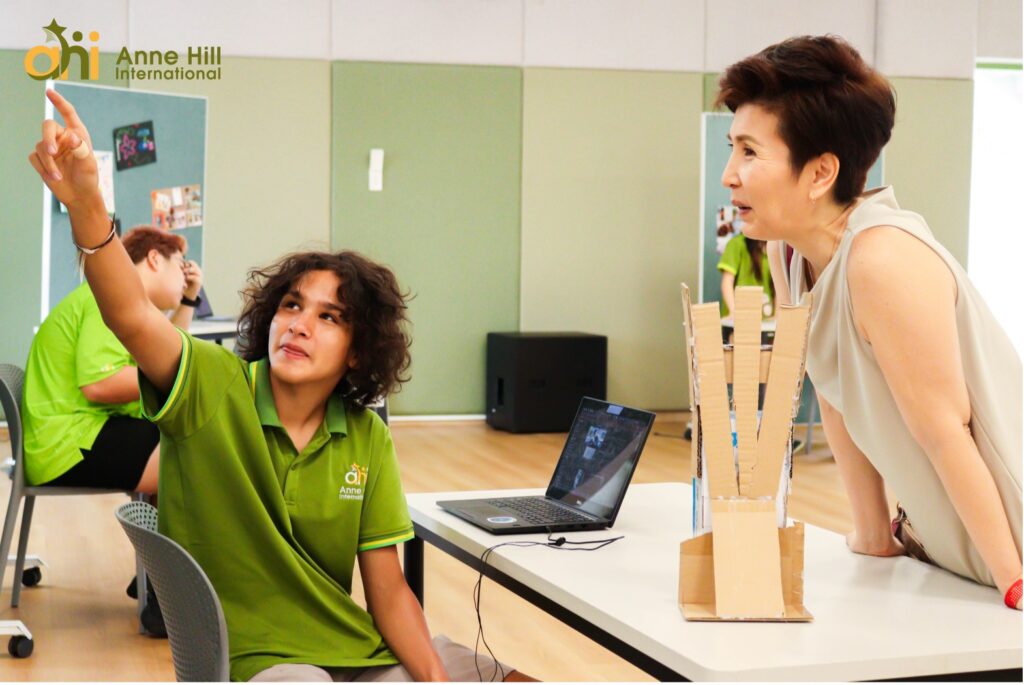
Photo: A parent supporting Year 9 students during their Exit Point.

Parents can support their children by encouraging them to manage their time, communicate with group members and share responsibilities fairly. They can also help with practical arrangements, such as gathering materials or organising group meetings. Lastly, show an interest in their child’s learning. Parents may ask questions about the project’s connection to the unit’s Big Idea or how it applies in a real-world context to spark your child’s curiosity and deepen their engagement with the topic.

As Mr. Matthew, Vice-Principal (Academic & Pastoral Care Y4–Middle Years), advises:

“Offer encouragement and guidance, but ensure the work remains your child’s own.”

Ultimately, Exit Points are an important opportunity for students to develop independence, responsibility and collaboration. With parental support and the freedom to take ownership of their work, students can build confidence in their abilities and take pride in their achievements.

Learning That Lasts: Holistic Education at AHI

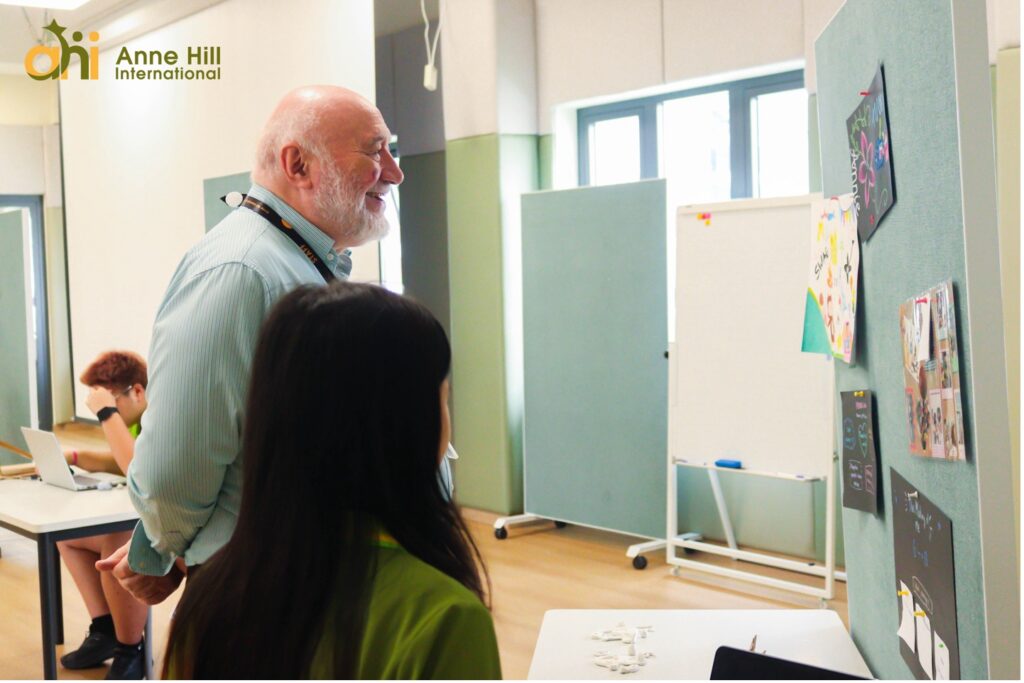
Photo: Mr Sean, Head of School, learning about the Year 9 students’ work and discoveries.

At AHI, holistic education is central to the school’s vision of nurturing “well-rounded, globally-minded, lifelong learners”. The IPC supports this vision by combining academic learning with personal and international development. Through Exit Points, students apply their knowledge to real-world contexts, make connections between subjects and explore different perspectives.

Learn more about Holistic Education at AHI.

As students develop their projects, they practise values such as resilience, empathy, collaboration and respect. Taking responsibility for their contributions, working through challenges with their peers and presenting their ideas also helps them build confidence, independence and communication skills.

These experiences extend beyond the completion of an Exit Point. By diligently preparing for and carrying out a group project, students develop the skills and values needed to navigate new challenges, understand different perspectives and continue growing as learners.

Discover AHI’s learning environment:

Book a School Tour at Anne Hill International School

Frequently Asked Questions (FAQs)

1. What is an Exit Point in school?

An Exit Point is the concluding stage of a unit in the International Primary Curriculum (IPC) or International Middle Years Curriculum (IMYC). Students bring together what they have learnt and share their understanding through projects, presentations, exhibitions or other creative activities.

2. How is an Exit Point different from a test?

Unlike a traditional written test, an Exit Point allows students to demonstrate their learning through practical projects and presentations. Students apply their knowledge, make connections across subjects and develop skills such as communication, collaboration and creative thinking.

3. Are Exit Points graded?

Yes. Exit Points contribute to students’ overall summative assessment. Teachers evaluate students’ work as part of the Exit Point assessment, which is considered alongside a subject assessment. Students receive an overall attainment judgement of Working Below, Working Towards, Working At or Greater Depth.

4. What is the difference between IPC and IMYC?

The International Primary Curriculum (IPC) is designed for primary-aged students, while the International Middle Years Curriculum (IMYC) is designed for students in the middle years. Both use thematic units to connect learning across subjects.

5. How can parents support their child before an Exit Point?

Parents can help their children plan their time, organise materials and communicate with group members. Most importantly, parents should offer guidance while allowing their children to take responsibility for their own contributions.

References